Monday, 1 June 2020

iron ore mineral resource

IRON ORE MINERAL RESOURCE


Iron ore is the most important mineral that is used to extract metallic Iron by Iron and Steel Industry. Extracted metal is widely used by secondary industries for manufacturing of machines, machine tools, construction of buildings etc. It is the most widely used metal because of its certain qualities like hardness, strength and durability. Further, iron is malleable and possess magnetic properties. Hence, Iron, because of its significance in manufacturing and development of infrastructure has wide economic importance.

The iron ore is found in following four types:
  1. Magnetite: It is the most important and best kind of iron ore. It contains about 72 percent metallic iron in it. It is black in colour.
  2. Hematite: It is also an important source. It contains about 60-70 percent metallic iron in it. It is red and brown in colour.
  3. Limonite: It contains about 30 to 40 percent metallic iron in it. It is mostly yellow in colour. It is a low-grade iron ore.
  4. Siderite: It has more impurities. It contains about 48 percent metallic iron content in it. It is brown in colour. It contains a mixture of iron and carbon. It is a low-grade iron ore

Hematite and magnetite are the two most important iron ores in India :


Iron Ore in Orissa : 
 The ores are rich in haematites. India's richest haematite deposits are located in:
1) Barabil-Koira valley.
2) Others: Sundargarh, Mayurbhanj, Cuttack, Sambalpur, Keonjhar and Koraput districts.

Iron Ore in Chhattisgarh
 Bailadila mine is the largest mechanised mine in Asia [Ore benefication only done here]
 A 270 km long slurry (a semi-liquid mixture) pipeline from the Bailadila to Vizag plant
transports the ore slurry.  Smelting is done in Vizag [Vishakhapatnam] iron and steel factory.
 Bailadila’s high grade ore is exported through Vishakhapatnam to Japan [No iron ore in Japan. But market is huge due to automobile industry] and other countries.
 The Dalli-Rajhara range is 32 km long [ferrous content 68-69 per cent] range with significant reserves.

Iron Ore in Jharkhand
 25 per cent of reserves.
 First mine in Singhbhum district in 1904.  Iron ore of here is of highest quality and will last for hundreds of years.
 Noamandi mines in Singhbhum are the richest.
Magnetite ores occur near Daltenganj in Palamu district.

Iron ore in karnataka

Iron ores are widely distributed. High grade ore deposits are those of Kemmangundi in Bababudan hills of Chikmagalur district and Sandur and Hospet in Bellary district. [Lot of Mining Mafia].

 Most of the ores are high grade haematite and magnetite.


Iron ore in other states
 Andhra Pradesh (1.02%): Kurnool, Guntur, Cuddapah, Ananthapur, Nellore.
 Maharashtra (0.88%): Chandrapur, Ratnagiri and Sindhudurg.
 Madhya Pradesh (0.66%).
 Tamilnadu: Salem, Tiruchirapalli, Coimbatore, Madurai etc.
 Rajasthan: Jaipur, Alwar, Sikar, Bundi, Bhilwara.
 Uttar Pradesh: Mirzapur.
 Uttaranchal: Garhwal, Almora, Nainital.
 Himachal Pradesh: Kangra and Mandi.
 Haryana: Mahendragarh.
 West Bengal: Burdwan, Birbhum, Darjeeling.
 Jammu and Kashmir: Udhampur and Jammu.
 Gujarat: Bhavnagar, Junagadh, Vadodara.
 Kerala: Kozhikode.

Iron Ore reserves (in descending order)

  1. Karnataka
  2. Odisha
  3. Jharkhand
  4. Chhattisgarh

Iron Ore production (in descending order)

  1. Odisha
  2. Goa
  3. Karnataka
  4. Chhattisgarh
The iron ore is widely distributed in the country:
Jharkhand
The iron ores here exist as hill masses which are close to coal fields. The iron ore generally occurs at the top of the hills, iron ore mining companies use aerial ropeways for bringing down the ore and pumping it into the railway wagons standing near the foot of the hills. The major iron ore mining areas in Jharkhand are Noamudi, Gua, Jamda and Kiriburu.

Chhattisgarh

Exploitable rich iron deposits are located in Dalli-Rajhara region of Durg district (close to Bhilai Steel Works), Bailadilla region of Dantewada district, Arindogi region and Raoghat region.

Odisha

The major iron ore mining centre is in Singhbhum district. The districts of Keonjhar, Mayurbhanj and Sundargarh also form the richest reserves of quality iron ore. The iron ore available here is Hematite which has about 60-70 percent metallic iron content. The iron ore from these sites is supplied to the iron and steel factories located at Rourkela, Jamshedpur, Asansol and Durgapur. The ore is also exported to different countries through the Paradip port.

Goa

The major iron ore mining centres are Sanguem, Safari, Ponda, Sahqualim, Bicholim and Quepem. The iron ore found in Goa is of high quality. The mining centres are located close to the port of Marmagao. The mines are worked by open-cast methods. They are close to rivers which enter the sea near the port. The iron ore is brought by road to jetties on the navigable rivers from which it is taken away to port for onward journey.

Karnataka

In Karnataka, the major iron ore mining areas are Baba Budan Hills, Kudremukh region, Hospet, Bellary, Chitradurga and Tumkur district. Iron-ore mined in Bellary and Hospet area is transported to Hospet from where it is sent to the ports of Chennai and Marmagao through railways for export to other countries.

Maharashtra

Maharashtra produces a very small amount of iron ore. Major mining ore areas include Chandrapur, Ratnagiri and Bhandara districts.

Andhra Pradesh

Iron ore is mined in small quantities in districts of Karimnagar, Warangal, Cuddapah, Kurnool, Adilabad and Anantapur.

Tamil Nadu

In Tamil Nadu, the areas where iron ore is mined are Tirthamalai Hills in Salem district and Yadpalli and Killiomalai areas in Nilgiris.


iron ore deposits in world : 
Stabilization of Iron Ore Mine Spoil Dump Sites With Vetiver ...
Location of significant BIF-hosted iron ore districts and deposits ...
major iron ore producer in world 2018-19
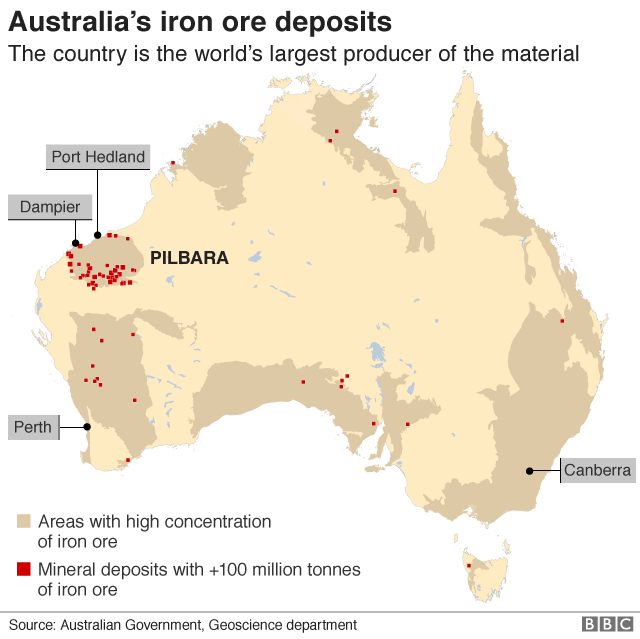
Australia and Brazil are among the world’s largest iron ore producers and hold a large portion of the world’s iron ore reserves. Australia makes up half of the world’s iron ore exports. Brazil exported around 23 percent of the world's total iron exports. As of 2019, Brazil had reserves of 15 billion metric tons of iron content and 29 billion metric tons of crude ore. Brazil produced 480 million metric tons of iron ore in 2019. Some of the world’s largest mines are found in Brazil, such as Vale’s Carajas iron mine in Northern Brazil. Carajas has approximately 7.2 billion metric tons of proven iron ore reserves. 

Russia

It has one of the largest proven reserves of iron ore. Important iron-producing regions of Russia are the Ural region, Kuzkas region in Siberia, Angara and Krasnoyarsk.

Ukraine

Good quality ore with high iron content is found in Kirvoj Rog region of Southern Ukraine, Kursk Magnetic Anomaly(KMA) and Kerch peninsula.

Europe


Sweden is an important region where good quality iron ore is found. Major areas of iron-ore mining in Sweden include Kiruna, Gallivare and Danmora. Another important region is Lorraine in France. Apart from this, Normandy, Pyrenees, Selsia and Phalia region of Germany, and Cleveland, Midland and Scotland region of United Kingdom are major mining ore areas of Europe.

North America

The major iron ore mining areas are the Lake Superior region including Mesabi, Vermillion, Marquette, Cuyana, Manomimi and Gogebic; Alabama state including the Birmingham and Red Mountain region of South Applatians; and in Canada including the Wright, Sept Isles and Schefferville regions.

South America

Brazil is known for its one of the largest reserves of iron ore in the world. Other important regions of iron ore mining are Orinoco Valley of Venezuela and La Sarena area of Chile.

Africa

The major iron ore mining areas of Africa are Liberia, South Africa, Algeria, Morocco and Tunisia. The iron and steel industry of Africa is still under-developed. As a result, most of the iron is exported.

Australia
Eighty tonnes in a single scoop: Mega-mining iron ore - BBC News
Pilbara region, Mt. Goldsworthy, Mt. Tom Price, Mt. Newman, Tailoring peak, Kalanooka region, Queensland, New South Wales and Tasmania are important iron ore bearing areas of Australia.

Asia

China has large iron ore reserves in Shenyang region of Manchuria; Muhar and Tahyeh region of Xinjiang valley. The Philippines has also good quality iron ore deposits in Mindanao.

Sunday, 31 May 2020

BAUXITE MINING IN INDIA AND WORLD

BAUXITE :


 80 % of bauxite [ore of aluminium] ore is
used for making aluminium.
 Found mainly as hydrated aluminium
oxides.
 Total resources == 3,480 million tonnes ==
84 per cent resource are of metallurgical grade

Bauxite Distribution in India

 Odisha alone accounts for 52 per cent
 Andhra Pradesh 18 per cent
 Gujarat 7 per cent
 Chhattisgarh and Maharashtra 5 per cent
each
 Madhya Pradesh and Jharkhand 4 percent.

Major bauxite resources are in the east
coast in Odisha and Andhra Pradesh.

 India manages to export small quantities
of bauxite.

 Major importers are Italy (60%), U.K.
(25%), Germany (9%) and Japan (4%).

Important Map Work Questions for Class 10 CBSE - Learn CBSE
UPSC Geography - Bauxite - Lead&Zinc - Tungsten - Pyrite | NeoStencil
Odisha
 Largest bauxite producing state.
 One-third of the total production of India.
Kalahandi and Koraput districts.
 Extends further into Andhra Pradesh
 The main deposits occur in Kalahandi,
Koraput, Sundargarh, Bolangir and
Sambalpur districts.

Chhattisgarh
 Second largest producer.
 Maikala range in Bilaspur, Durg districts
and the Amarkantak plateau regions of
Surguja, Raigarh and Bilaspur are some of
the areas having rich deposits of bauxite.

Maharashtra
 Third largest producer.
 Largest deposits occur in Kolhapur
district.
 Kolhapur district contain rich deposits
with alumina content 52 to 89 per cent.
 Other districts: Thane, Ratnagiri, Satara
and Pune.

Jharkhand
 Ranchi, Lohardaga, Palamu and Gumla
districts.
 High grade ore occurs in Lohardaga.

Gujarat
 Jamnagar, Junagadh, Kheda, Kachchh,
Sabarkantha, Amreli and Bhavnagar.
 The most important deposits occur in a
belt lying between the Gulf of Kachchh
and the Arabian sea through Bhavnagar,
Junagadh and Amreli districts.

M.P.
 Amarkantak plateau area, the Maikala
range in Shandol, Mandla and Balaghat
districts and the Kotni area of Jabalpur
district are the main producers.

Bauxite Distribution – World
 Australia (31.34%),
 China (18.41%),
 Brazil (13.93%),
 Guinea (8.36%), etc.
school lunchroom | We Future Cycle

MANGANESE MINERALS IN INDIA & WORLD

Manganese
 Manganese is not found as a free element
in nature.
 It is often found in combination with iron.
 The most important manganese ore is
pyrolusite.
 Manganese is primarily used in iron and
steel industry.
 It is the basic raw material for
manufacturing steel alloys.
 6 kilograms of manganese is required for
manufacturing one tonne of steel.
 Manganese is also used in the
manufacturing of bleaching powder,
insecticides, paints, and batteries.
                                        Indian manganese ore deposits occur mainly as metamorphosed bedded sedimentary deposits associated with Gondite Series (Archaeans) of Madhya Pradesh (Balaghat, Chhindwara & Jhabua districts), Maharashtra (Bhandara & Nagpur districts), Gujarat (Panchmahal district), Odisha (Sundargarh district) and with Kodurite Series (Archaeans) of Odisha (Ganjam & Koraput districts) and Andhra Pradesh (Srikakulam &Visakhapatnamdistricts).

Statewise, Odisha tops the total reserves/ resources with 44% share followed by Karnataka 22%, Madhya Pradesh 12%, Maharashtra & Goa 7% each, Andhra Pradesh 4% and Jharkhand 2%. Rajasthan, Gujarat, Telangana and West Bengal together shared the remaining 2% resources

Besides, manganese ore production was reported as associate mineral by 12 mines in 2018-19.
In 2018-19, twenty-four Public Sector mines jointly accounted for 46% of the total production. The contribution of captive mines was 10% of the total production. Madhya Pradesh, the leading manganese ore producing State, accounted for 33% of the total production in 2018-19, which is followed by Maharashtra (27%) and Odisha (16%) .

Major producers and mines :
1) Madhya Pradesh :
Balaghat 30(1) Chhindwara 4 Jabalpur 5(4) Jhabua (1)
2) Maharashtra 20 :
Bhandara 2 Nagpur 18
3) Odisha 30(4) :
Keonjhar 17(2) Sundargarh 13(2)
4) Andhra Pradesh 27
Vizianagaram 27
5) Karnataka 9(2)
Ballari 1(2) Chitradurga 3 Davanagere 4 Tumakuru 1
6) Telangana 6
Adilabad 6
7) Jharkhand 4(1)
Singhbhum (West) 4(1)
8) South Goa 2
9) Gujarat 1*
Panchmahals 1*
10) Jharkhand 4(1)
Singhbhum (West) 4(1)
11) Rajasthan 1
Banswara 1

Uses of manganese :
                                 Manganese improves strength, toughness, hardness and workability of steel, acts as a deoxidiser and desulphuriser and also helps in getting ingots free from blowholes. About 90 to 95% world production of manganese ore is used in metallurgy of iron and steel.
                                 Manganese dioxide is used for manufacturing dry cell batteries in which it functions as a depolariser of hydrogen.
                                 Manganese ore is also used in the manufacture of various chemicals, such as, potassium permanganate, hydroquinone, manganese sulphate, manganese chloride, manganese phosphate, etc. In Chemical Industry, generally high-grade material is used for potassium permanganate. Requirement of manganese dioxide for Explosive and Pyrotechnic industries .
       
                             Pyrolusite is used generally to impart glaze to the pottery and to make coloured bricks. It also finds use as driers for oils, varnishes and paints. Manganese sulphide is used in the manufacture of salts and in calico printing. Manganese chloride is used in cotton textile as a bronze dye. Manganese salts are used in photography and in leather and matchbox industries.


Manganese Ore Distribution in India
 India processes second largest reserves in
the world after Zimbabwe; 430 million
tonnes
 India is the world's fifth largest producer
of manganese ore after China, Gabon,

South Africa and Australia.
Maharashtra, Madhya Pradesh, Odisha,
Andhra Pradesh and Karnataka are the
major manganese producing states.
 Maharashtra and Madhya Pradesh
together produce more than half of India's
manganese

State wise reserves of Manganese

 Odisha (44%),
 Karnataka (22%),
 Madhya Pradesh (13%),
 Maharashtra (8%),
 Andhra Pradesh (4%)
 Jharkhand and Goa (3% each),
 Rajasthan, Gujarat and West Bengal

(remaining 3 per cent).

Maharashtra
 Produces about 27.66 per cent of Indian
manganese.
 The main belt is in Nagpur and Bhandara
districts.
 High grade ore is found in Ratnagiri
district also.

Madhya Pradesh

 Produces about 27.59 per cent of India's
manganese ore.
The main belt extends in Balaghat and
Chhindwara districts.
 It is just an extension of the Nagpur
Bhandara belt of Maharashtra.
Odisha
 24 per cent production. [1st in reserves but
3rd in prduction]
 Gondite [regional names] deposits occur
in Sundargarh district and Kodurite and
Khondolite deposits in Kalahandi and
Koraput Districts.
 Manganese is also mined from the lateritic
deposits in Bolangir and Sambalpur
districts
Andhra Pradesh
 13% of India's manganese production.
 Srikakulam and Vishakhapatnam
districts.
 Srikakulam district has the distinction of
being the earliest producer (1892) of
manganese ore in India.
 Cuddapah, Vijayanagaram and Guntur

are other manganese producing districts.
Karnataka
 6 per cent of India's manganese.
 Uttara Kannada, Shimoga, Bellary,
Chitradurg and Tumkur districts.
Other producers
 Goa,
 Panchmahals and Vadodara in Gujarat,
 Udaipur and Banswara in Rajasthan and
 Singhbhum and Dhanbad districts in
Jharkhand are other producers of
manganese.
Export of Manganese
 Four-fifths of the total production is
consumed domestically.
 Exports constantly decreasing due to
increasing domestic demand.
 Japan is the largest buyer of Indian
manganese.
 The other buyers are the USA, UK,

Germany, France, Norway.


World manganese reserves:

Reserves are located in South Africa (32%), Brazil (17% ), Australia (12%), Gabon (8%), China (7%) and India (4%).

It is fact that continues to prompt and support interests in deep-sea manganese nodules, which constitute an enormous untapped resource. Most nodules are found in areas of deep-sea floor at water depths of 5 to 7 km.The Pacific Ocean alone is estimated to contain about 2.5 billion tonnes nodules containing about 25% Mn, making them similar in abundance to low-grade land-based deposits.

World Major producers of manganese :

South Africa was the leading producer contributing about 28% followed by China (17%), Australia (14%), Ghana (9%), Gabon (8%), Brazil (6%), India (5%) and Ukraine (3%)

Polymettallic manganese nodules 4 proven reserves under deep sea mining are :
1) Clario clipptron basin from Hawaiian to California 
2) penrhyne basin near new Zealand 
3) Peru basin
4) central Indian Ocean basin

L 26 JET STREAM CAUSES TYPES AND ROLE

JET STREAM & ITS SIGNIFICANCE MEANING AND ORIGIN  CHARACTERISTICS TYPES AND ITS DISTRIBUTION CAUSE AND MECHANISM WEATHER ASSOCIATED WITH...