Friday, 19 July 2024

India's Maize Green Revolution


India’s Green revolution in maize :

Maize is used as feed crop for poultry(60%) and livestock(15-20%) ,  human consumption (20%) , biofuels (ethanol production)and industries such as textiles, paper and pharmaceuticals .

Maize production in India: 

— since, 1999-2000 production of maize has tripled from 11.5million tonnes to 35 million tonnes.
—- yield per hectare double from 1.8 to 3.3 tonnes on average 
—- India is the 5th largest producer of maize and it 3rd largest cereal crop after rice and wheat accounting 10% of total food grains production in the country.
—- major state’s production: Karnataka, Madhya Pradesh, Maharashtra, Rajasthan, Uttar Pradesh, Bihar telangana, Gujarat, Tamil Nadu and Jammu and Kashmir.
—- growing season: Kharif crop (85%) and rest through out the year.

Cause of maize green revolution:

—- Cross pollinating hybrid seeds of maize unlike self pollinating wheat and rice, commercially viable, 80% produce by private sector.
—- ICAR bred first waxy maize hybrid with high amylopectin starch content(soft), making better for ethanol production .
—- hybrid yields 7.3 to per hectare 
—- maize double haploid (DH) facility in kunigal in Karnataka producing varieties with higher yield, tolerance to heat, drought, nutrient, pest attack, etc
—- private companies developing and promoting high yield maize 
—- government initiatives such as NFSM, RKVY is also improving maize varieties.

Tuesday, 9 July 2024

Urbanization in India Heating Up Our Cities


URBANIZATION DRIVEN WARMING : 


Context : 

Cities in India are experiencing warming at nearly twice the rate compared to the rest of the country, according to a recent study published in the journal Nature.The study found that cities in India are warming at an average rate of 0.53°C per decade, with urbanisation contributing 0.2°C. Urbanisation is contributing the increase in warming 60%. Study done by IIT, Bhubaneswar published in nature.


The researchers ranked 141 cities based on warming attributed to climate change (regional effect) and urbanisation (local effect). 


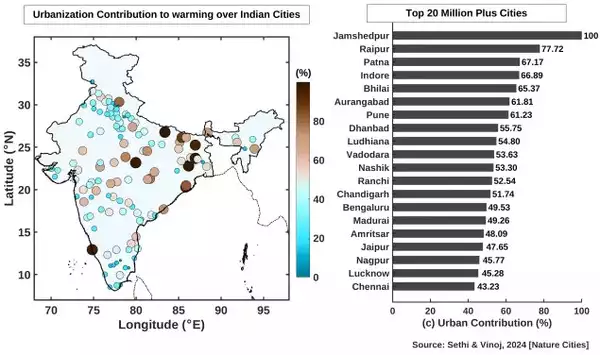
In cities such as Jamshedpur, Raipur, Patna, Indore, Bhilai, Aurangabad, Pune, Dhanbad, Ludhiana and Vadodara, urbanisation contributed more than 50% to overall warming. In particular, urbanisation contributed to 100% of the warming in Jamshedpur.


“The urban contribution is seen to be higher in cities in the eastern and central Indian regions, One possible explanation could be that these (eastern and central Indian) cities have gained momentum in urban growth in recent years, and hence, the rate of growth at which heat is trapped within these cities is higher than the older cities that are already large, and hence, the rate of growth is smaller.


CAUSES OF WARMING INDIAN CITIES


  1. Urban heat Island effect

  2. Regional climate change or global warming


Urban Heat Island:

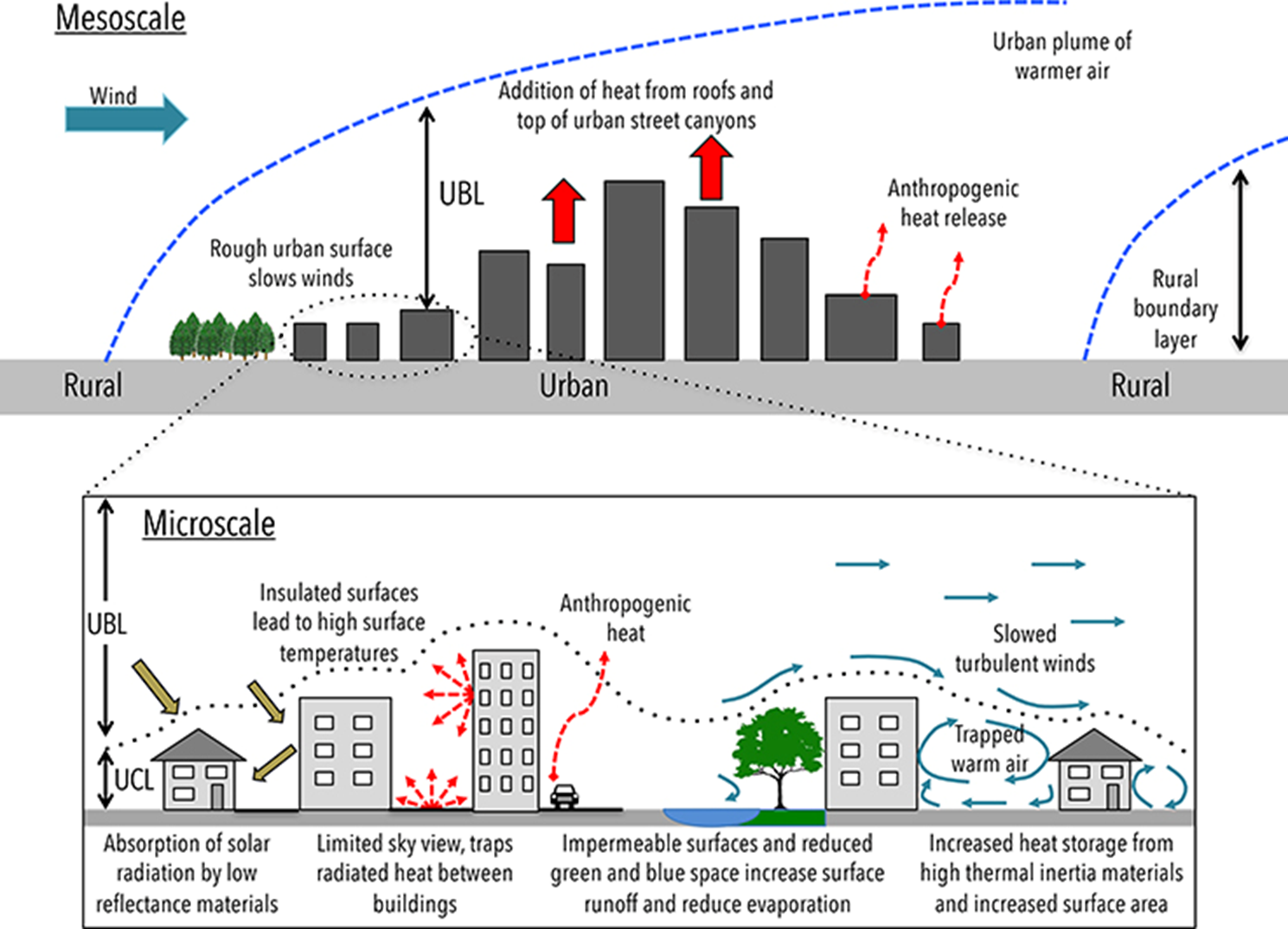
  • Urban heat island may be defined as the local and temporary phenomenon in which certain pockets within a city are experiencing higher heat load than its surrounding area.

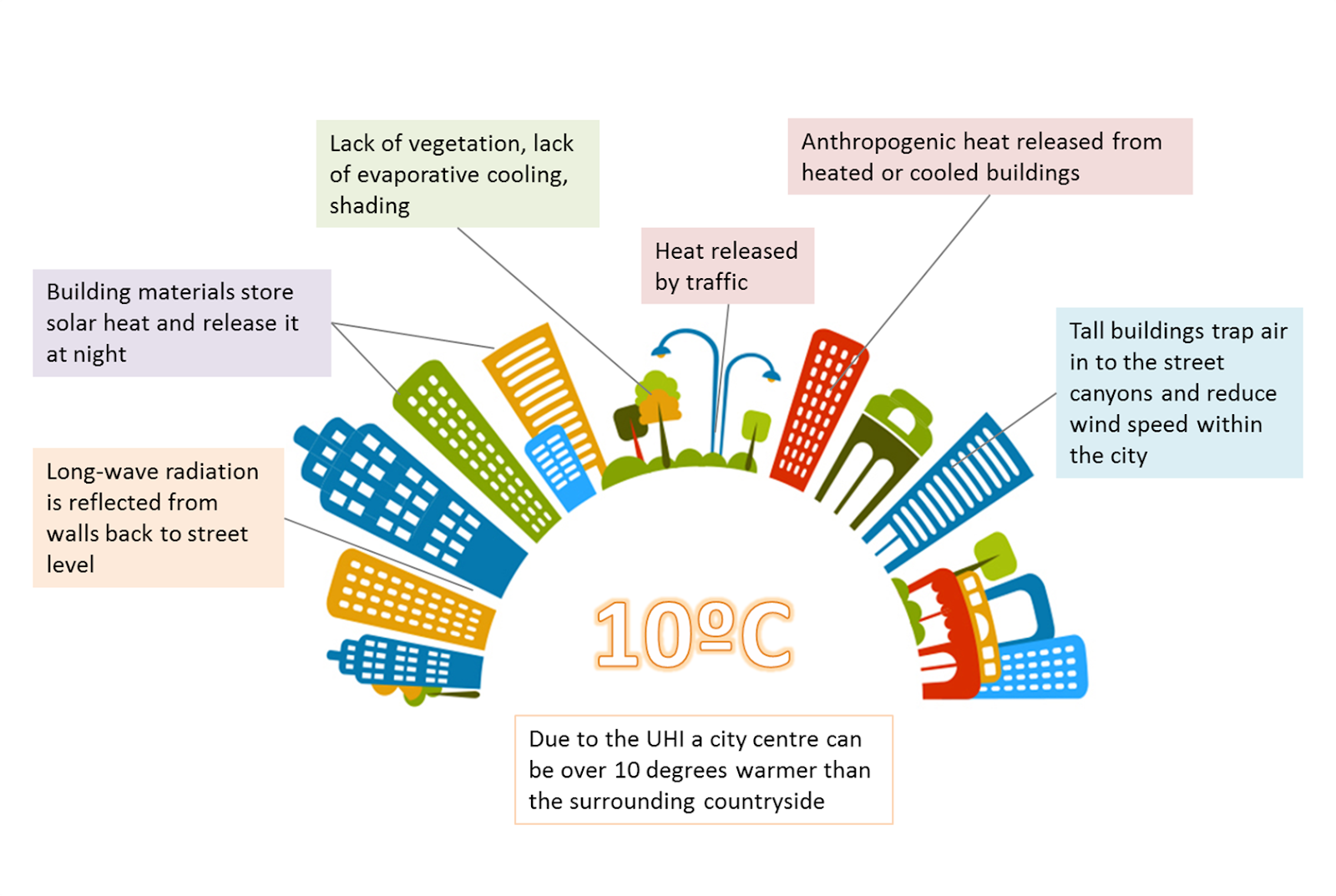
  • This rise of heat basically happens due to buildings and houses of cities made up of concrete and roads and pavement made up from Asphalt where the heat is trapped and not able to dissipate easily.

  • Irregular height of buildings trapped the outgoing heat waves(IR waves) called urban canyons effect.

  • Lack of vegetation cover and water bodies due to congestion , lack of open spaces , natural cooling effect reduces.

  • Heat released by urban activities by vehicles, industries, commercial and household heating and cooling activities such as carbon emissions and other pollutants.

  • Reduced green and blue spaces on ground increases the surface runoff and reduces evaporative cooling rates.

  • More absorption of solar radiation by low reflectance/albedo materials used in construction such as concrete/asphalts,steel,etc referred to as high thermal inertia materials.

  • All the above factors and processes develops the urban heat plumes and urban heat dome that raise the temperature of urban areas both in day and night time than the rural areas.

  • Urban heat island is basically induced due to trapped heat between establishments made up of concrete.

  • The positive thermal anomalies within cities remain higher between 3 to 5 degrees Celsius and may reach to 10 degree celsius.

  • By 2050, India’s Urban growth led to an additional 450 million people to cities i.e., 68% of urbanization level by 2050.


Regional global warming induced by human induced climate change : greenhouse gases emission : 

  • Climate change is causing significant increases in record-breaking temperatures and prolonged heat waves, contributing to complex warming in cities.

  • According to the Global Climate Risk Index 2021, India is the 7th profound impacted country in the world due to climate change extremes like heat waves,etc


Impacts of warming of cities by combined effect of urbanisation and climate change : 


  • Results showed that the rate of warming in cities is nearly twice that of the rest of the country, with urbanization alone causing additional warming of about 60%.

  • An average increase of 0.53°C per decade in night-time land surface temperature was observed, with tier-II cities in eastern India experiencing stronger urbanization-driven warming than larger metros.

  • Recently, Delhi experienced daytime temperatures above 50°C for two consecutive days, the highest ever recorded in the city.

  • Cities are experiencing higher temperatures due to ongoing climate change and rapid urbanization, which are defining the Anthropocene.

  • Heat waves in cities causing poor air quality, increased heat related health issues like cramps, heat stroke,death, dehydration,

  • Economic loss due to infrastructural damages, labor productivity loss, fires in buildings,etc   


Mitigation measures against cities warming : 


  • This altered micro-climate affects heat, rainfall distribution, air pollution dispersion, and public health, necessitating scientifically informed urban planning.

India’s efforts to reduce warming effects:

  • India is actively reducing emissions and shifting to non-fossil fuel energy sources, as outlined in its updated nationally determined contribution (NDC) for climate justice.

  • State-level heat action plans and early warning systems for heatwaves show India’s commitment to reducing heat-related mortality.

Recommendations:

  • Tailored city-specific action plans are needed for sustainable urban growth, considering the predominant contributors to warming.

Urban heat management should follow a differential approach:

  1.  local-scale interventions (cool roofs, green infrastructure, urban forests) for cities with high urbanization contributions, and

  2.  regional-scale efforts (large-scale afforestation, rejuvenation of water bodies) for cities with higher climate change impacts.

  3. Pollution control norms through policy interventions like shifting industries away from cities, e-vehicles, clean and green fuels, absorption of greenhouse gases, 

  4. Heat action plans ready like mapping and zoning of core areas, early warning, cooling public places & shades, water availability, hospital preparedness for emergency.

  5. Urban planning components includes garden city concept, urban forestry, smart and sustainable cities, open spaces for green and blue infrastructure, 

  6. Geo-engineering methods like whitening of roads and roofs, urban canyon reduction by design of building and its heights, solar tiles, material of construction changed to be more reflective, lower interia, higher albedo,etc.

Monday, 8 July 2024

Earth's Inner Core Slowing Down and Reversal


INNER CORE SLOWING DOWN SINCE 2009 AND REVERSE AFTER 2023 STUDY


The inner core of the Earth's movements are slowing down and also is moving in reverse direction or backwards according to confirmation done by scientists.

Scientists have been observing the core since 1936, it is not easy to observe the Earth's inner core. Danish seismologist Inge Lehmann made this inner core discovery.

There is increasing evidence suggesting that the inner core's spin is changing dramatically in recent times and scientists have solved this mystery as to why this is happening and what it means.

Scientists have used the method of the earthquake to identify the inner core moments, the P and S waves emerge during the earthquake and observing and studying it helps the scientist these seismic waves explain the inner Earth situation. The data of the seismic moment was first published in 1990, according to recent studies and reports of 2023 the core that used to spin faster than the Earth itself is now spinning slower.

The Nature Journal article published on  12 June 2024, explains the backward moments of the inner core in detail. The cause of these movements is that the solid contains iron and nickel whereas the outer core is liquid. The Earth’s magnetic field influences the movement of the inner core, particularly in the active region where the inner and outer cores meet.

Studying the rotation of the inner core is crucial for a deeper understanding of our planet. It allows scientists to develop comprehensive dynamic models of the Earth's systems. Additionally, examining seismic waves can improve our understanding and management of earthquakes. 

Earth's core

Earth's core is the hottest part of the planet, equivalent to that of the Sun's surface. The core is buried around 5,180 kilometres deep inside the Earth and consists mainly of iron and nickel. The inner core is surrounded by a liquid metal outer core, which acts as a barrier with the rest of the Earth. This barrier allows Earth's core, akin to a hot solid ball of metal, to spin independently and not necessarily align with the rest of the planet

Is the rotation speed of Earth's core slowing down?

Danish seismologist Inge Lehmann discovered the planet's inner core in 1936. Since then, scientists have continued to debate its rotation speed and direction. One reason scientists have limited evidence to prove their point is that it is impossible to observe or collect direct samples of Earth's deep interior. Most of the research and studies are based on variations between waves of similar strengths passed through the core at different times.

Data from seismograms from repeated earthquakes and explosions on Earth indicate that the rotation speed of the solid inner core has been constantly degrading compared to the Earth's surface over the past few years, according to a new finding published in the journal Nature in June this year.

The new findings also confirm that the changes in rotational speed follow a 70-year cycle.

The implications of the inner core's slowdown for our planet remain an open question, with some experts suggesting that Earth's magnetic field could be affected.

CAUSE OF SLOWING OF INNER CORE: 

Buried about 3,220 miles (5,180 kilometres) deep inside Earth, the solid metal inner core is surrounded by a liquid metal outer core. Composed mostly of iron and nickel, the inner core is estimated to be as hot as the surface of the sun - about 9,800 degrees Fahrenheit (5,400 degrees Celsius).

Earth's magnetic field pulls on this solid ball of hot metal, causing it to spin. Meanwhile, the gravity and flow of the fluid outer core and mantle exert a drag on the core. Over many decades, the push and pull of these forces have resulted in variations in the core's rotational speed, according to Vidale.

The movement of metal-rich fluid in the outer core generates electrical currents that power Earth's magnetic field, which protects our planet from harmful solar radiation. Although the inner core's direct influence on the magnetic field is not fully understood, scientists reported in 2023 that a slower-spinning core could potentially impact it and also slightly shorten the length of a day.

Dr Vidale and his coauthors observed seismic waves produced by earthquakes in the same locations at different times for this study. They found 121 examples of such earthquakes occurring between 1991 and 2023 in the South Sandwich Islands, an archipelago of volcanic islands in the Atlantic Ocean to the east of South America's southernmost tip. The researchers also looked at core-penetrating shock waves from Soviet nuclear tests conducted between 1971 and 1974. 

IMPLICATION OF SLOWING INNER CORE : 

  1.  The researchers highlighted that when the core spins slowly, the mantle speeds up. This shift makes Earth move faster, and the length of a day shortens. 

  2. The scientists feel that one possibility could be metal inner core is not as solid as expected. 

  3. Although the inner core's direct influence on the magnetic field is not fully understood, scientists reported in 2023 that a slower-spinning core could potentially impact it and also slightly shorten the length of a day.


Tuesday, 2 July 2024

Stampede Disaster in India Causes and Prevention


Stampede as a disaster in India


Stampede or crushing is the surge of individuals in a crowd, in response to a perceived danger or loss of physical space. It often disrupts the orderly movement of crowds resulting in irrational and dangerous movement for self-protection leading to injuries and fatalities


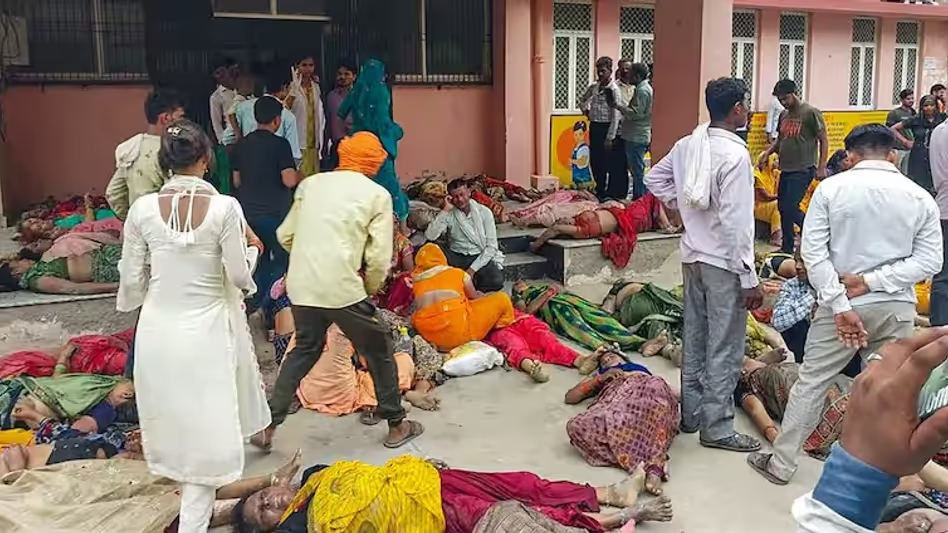
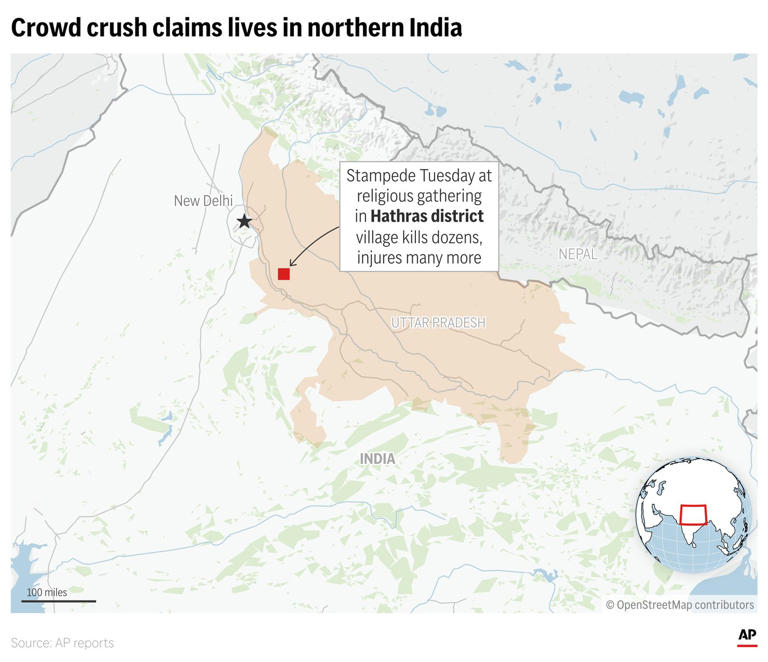
Context :In Hatras,UP A stampede at a religious congregation .here killed over 100 people on Tuesday as devotees suffocated to their deaths and bodies piled atop each other in the worst such tragedy in recent years.

The stampede occurred during a crowded religious gathering, leading to chaos and a significant number of casualties. The exact cause of the stampede is still under investigation.


Introduction: The recurring stampedes at places of mass gathering, including religious places, railway stations, sports/social/political events, etc. are a great concern . With population explosion, urbanisation, more mass gatherings events led to more chances of such man made disaster of crowd management or stampede. Government of India NDMA guidelines consider as crowd disaster are local events and organizers are prime responsibility of disaster management in support of local administration.

With population growth and a constant increase in human travels, mass gatherings are becoming more frequent and attract increasing numbers of participants. Mass gatherings can be defined as a concentration of people at a specific location for a specific purpose over a set period of time, and which has the potential to strain the planning and response resources of the country or the community. Mass gatherings are either spontaneous, such as at train stations during rush hour or are planned, such as at sport, cultural, religious, or political events.  Mass gatherings may affect health in different ways and crowd disasters may occur, including the collapse of infrastructure, fire incidents, terrorist attacks, violence riots, and human stampedes 

Most human stampede casualties result from traumatic asphyxia caused by external compression of the thorax and/or upper abdomen, resulting in complete or partial cessation of respiration. It has been reported that significant compression forces can be present with even moderate crowds; forces of up to 4500 N (1000 lb) can be generated by just six to seven people pushing in a single direction with forces large enough to bend steel railings. 


Examples of recent crowd disasters in India 

  1. Dabwali Haryana, 23 December,1995. Fire at a school function held in a shamiyana(tent)

  2. Baripada, Odisha, 24 feb 1997. A fire at religious congregation 

  3. Uphaar cinema Delhi, 13 June 1997. Fire in movie hall

  4. Sabarimala stampede, kerala in January 14 (1999) and 2011.

  5. Charbagh railway station stairs, Lucknow (28 September,2002)-U.P

  6. Nasik maha kumbh mela, Maharashtra 27 August 2003

  7. Wai Satara , Shri Kalu ai yatra Mandharadev, Maharashtra, 25 January 2005 killing 293 people 

  8. Naina Devi temple stampede in Bilaspur, Himachal Pradesh, 3 august 2008 killing 162 people 

  9. Chamunda Devi temple, Jodhpur, Mehrangarh fort Rajasthan,30 September 2008 killing 249 people 

  10.  Ram Janki temple, Pratapgarh, local ashram , Uttar Pradesh, 4 march 2010 killing 65 people 

  11.  Railway station, Allahabad, while boarding train UP, 10;feb 2013

  12.  Ratangarh temple, Datia, a stampede on a bridge where a section of railings broke in Madhya Pradesh, 13 October 2013 killing 121 people 

  13.  Hathras religious congregation in UP, 2nd July 2024 killing around 117 people 


Causes of Stampede

Structural factors and poor crowd control measures lead to stampedes.

1. Structural Factors  

  • Insufficient exits, narrow passageways, and poorly designed venues can impede the flow of people during events or emergencies, increasing the risk of stampedes.


2. Poor Crowd Management

  • Underestimation of the audience 

  • Crowd Behaviour: The influx of people in a gathering that triggers a stampede occurs when individuals perceive a threat or a lack of personal space. This disruption frequently hampers the organized flow of the crowd, resulting in chaotic and hazardous movements driven by the instinct to protect oneself. As a consequence, injuries and even deaths can occur.  


3. Panic and Fear

  • Stampedes can be triggered by panic and fear within the crowd. Factors such as sudden loud noises, rumours of danger, or perceived threats can create a sense of panic, causing people to rush and trample over each other in an attempt to escape the perceived danger. 


4. Poor coordination between Stakeholders

  • Stampede can happen due to a lack of understanding of the range of duties entrusted, communication delays, coordination gaps between agencies etc. 

5) fire / electricity : unauthorised fireworks, illegal electric connections, short circuit, fire extinguisher not working, building violates fire code, fire in a makeshift facility, fire in illegal structures 

6) security lapses: Under deployment of security personnel to regulate crowd, lack of scientific planning , lack of training and equipment 

Note: Deaths from stampedes occur primarily from compressive asphyxiation. 

Dealing with Stampede Disasters

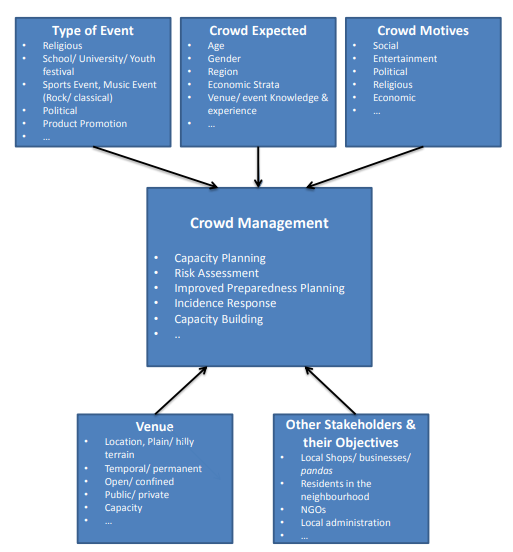
Risk Analysis and planning should be the first step. All event organizers should conduct a Failure Mode and Effect Analysis (FMEA). 

  • Information management dissemination is crucial. The absence or poor information management in itself may be a source of crowding.  

  • Capacity Planning (Long term and Short term): It emphasizes the need to develop infrastructure based on popularity, periodicity of the event, weather, terrain and local population. 

  • Understanding Crowd Behaviour: The behaviour of an individual in a crowd is influenced by the behaviour of others. The unlawful actions of a few people can result in a larger number following them. 

  • Crowd control-The guiding principle for crowd control should be managing the demand-supply gap by controlling the crowd inflow, regulating the crowd at the venue and controlling the outflow if needed. 

  • Stakeholder approach-organizers/law enforcement agencies must encourage community stakeholders (NGOs, Business Associations, Schools/Colleges, neighbourhoods, societies. Mohall committees etc.) to take ownership in events to uphold unity of purpose, faster decision/response, better coordination etc.  

  • Training: Training crowd management personnel, providing instructions on normal and emergency crowd movement and conducting mock drills is essential to prevent crowd disasters.

  • Technology: Use of Technology like remote sensing, GIS, CCTV,UAv etc., to improve the crowd experience and crowd control.

  • Deployment of barriers : barricades, roadblocks and fencing may be deployed in target areas as deemed fit to control the foe of people and vehicles 

  • Facilities and emergency medical services 

  • Transportation and traffic management 

  • Establishment of emergency operations centre: integrated communication system, public address system,announces, display system, wireless, medical emergency section, security control centre


L 26 JET STREAM CAUSES TYPES AND ROLE

JET STREAM & ITS SIGNIFICANCE MEANING AND ORIGIN  CHARACTERISTICS TYPES AND ITS DISTRIBUTION CAUSE AND MECHANISM WEATHER ASSOCIATED WITH...