It is the most stable allotrope of Carbon, with standard entropy being zero. It is the only non-metal element which is a good conductor of electricity. It is also known as a dry lubricant for its greasy feel. It has many industrial applications, especially for products that need very high heat.
Reserves in India :--
The Geological Survey of India (GSI) in its report revealed that about 35 % of India’s total Graphite reserves is found in Arunachal Pradesh. This is the highest found in country.
Importance of graphite minerals :-
Graphite is an excellent conductor of heat and electricity and also has the highest strength of any natural material. However, it wasn’t until recently that the metal began to gain popularity.
Interest in graphite mining is increasing in large part because lithium-ion batteries are becoming more and more common. These batteries are used in everything from phones to electric vehicles, and graphite is one of their key raw materials. As the use of lithium-ion batteries continues to increase, graphite demand is expected to rise at least in the next few years.
Issue: At present India imports majority of Graphite from other countries.
Importance: With 35 % of India’s Graphite deposits being found in Arunachal Pradesh, the State could now be developed as leading producer of graphite in country thus helping in meeting its future needs.
Suggestions: The Arunachal Pradesh’s secretary of Department of Geology and Mining suggested that the survey and drilling activities of GSI should be moved towards India-China international Border.
As per the reports China is undertaking huge graphite mining activities across the border in Tibet Autonomous Region. Therefore, road and infrastructure development towards the (Sino-India) international border should act as a boon for exploration and extraction of mineral at the same time meeting India needs and reducing imports.
* Due to land and sea breezes world experience 'seasonal winds'.
* Seasonal wind is known as Monsoon.
* Tropical Monsoon : On-shore wet monsoons on lands during summer and off-shore dry monsoon in the winter.
* Monsoon is seasonal winds which change in direction with change in season.
* In summer appear sea to land breezes and in winter land to sea breezes.
Origin of Word 'Monsoon' :
* The word monsoon has been derived from Arabic word Mausin. Mausin means season.
* Seasonal winds best develop in Indian subcontinent (in Asia - Southern Asia and South East Asia).
* Word Mausim pronounced as 'Mausam' in India and neighbouring countries.
* Sometimes weather of Indian subcontinent is unpredictable, because of it in layman language - kya mausam hai ! (What is Monsoon !).
Indian Monsoon (Indian Mausam) :
Annually, India experience for seasonal division but Indian monsoon occur in two divisions, they are -
1. The Southwest Monsoon Season : Most of the rainfall in India received from Southwest monsoon, which occurs in June to September.
2. The Retreating Monsoon Season : Appear Clear skies, cool and dry season in the months of October and November are known as retreating monsoon.
* Formation of Southwest Monsoon :
+ Intense heating of land mass of Indian subcontinent (especially Tibetan plateau) during summer.
+ Formation of high pressure belt in the South Indian Ocean (east to north-east of Medagascar in Summer).
+ Formation of Southwest Monsoon in mid-June to September.
+ Heavy rainfall in Indian subcontinent.
* Influence Southwest Monsoon :
+ Orographic features.
+ The hot and dry season (march to mid-June) due to this low pressure created on Indian-subcontinent.
+ Subtropical jet stream (from west to east).
+ Tropical Easterly Jet stream (African Jet stream).
+ Formation of Indian Ocean Dipole.
+ Shifting of Inter Tropical Convergence Zone (ITCZ).
* Formation of Retreating Monsoon :
+ Rainfall decreasing after second week of September.
+ Rainy season gradually moving towards southward after mid September is known as retreating monsoon.
+ First withdrawal of Southwest monsoons in Punjab plain.
+ The skies are clear cool and dry season.
+ This will lead to form North East monsoon.
Theory of Origin and Growth of Indian Monsoon :
* The origin of monsoon is still not well known.
The theory regarding origin and growth of monsoon have classify in Two types -
1. Classical Theory
2. Modern Theory
1. Classical Theory of Indian Monsoons :
+ Monsoon are mentioned in old scriptures like the Rig Veda as well as writing of Buddhist and Greek scholars.
+ The first credit for scientific study goes to Arab scholar Al-Masudi (a trader) in 10th century A.D.
+ Arab trader use the sea route to carry out trade with India and monsoon pattern were of prime importance for them.
+ He gave an account of the the reversal ocean currents and the monsoon winds over the North Indian Ocean.
Classical Theory of Indian Monsoons : Sir Edmund Halley's Theory :
He gave Indian Monsoon theory in 1686.
His theory is based on Thermal concepts.
Summer Monsoon :
+ In summer the sun appear vertically over the Tropic of Cancer resulting in high temperature and low pressure in Central Asia.
+ The high pressure over Arabian Sea and Bay of Bengal. Hence winds flowed from Ocean towards landmass in summer.
+ This flow of winds bring heavy down pour to the Indian subcontinent.
Winter Monsoon :
+ In winter Sun appear vertically over the Tropic of Capricorn.
+ High pressure form over land and low pressure over ocean.
+ Winds will blow from land to sea.
Limitations : The monsoons do not develop equally everywhere on earth and the thermal concept of Halley fail to explain the difficulties of Monsoon such as the sudden burst of monsoons, delay in on set of monsoons sometimes, etc.
Modern Theory of Indian Monsoons :
* Role of Inter Tropical Convergence Zone (ITCZ) - It meeting zone of southeast trade winds and northeast trade winds near the equator.
* Role of Himalaya - Himalaya act as mechanical barrier to the sub-tropical westerly Jet stream.
* Over ITCZ - cumulus nimbus cloud form and heavy rainfall.
* Shifting of ITCZ due to intense heating of Tibetan Plateau.
* El-Nino - It create drought like conditions in Indian subcontinent.
* La-Nina - appear flood like conditions in Indian subcontinent.
* Role of Indian Ocean Dipole.
* Role of Madden jullian oscillation
Impact of monsoon :
60% depends on agriculture
Regional variations in monsoons help in growing diversity of crops.
* Differences in monsoons in India is reflected in vast variety of food, clothes and house types.
* Monsoon rain helps recharge dams, lake, and reservoirs.
* They help in generate hydro-electric power.
* To relief for drought area.
* Grow water intensive crops.
* beneficial to natural vegetation zones and boost biodiversity which has it's own socio-economic benefits.
*
Limitations -
* It may be double edged sword problems like drought or flood.
* Extreme climate resulted as crop failure.
* Damage of crops - Farmer commit suicide e.g. in Maharashtra, MP, Telengana.
* Famine & starvation.
* Simultaneously presence of Southwest monsoon and western disturbances can cause cloudburst e.g. Kedarnath.
* Monsoon break can also cause heavy flooding in the rivers.
Weather Forecasts in India :
* Before the era of computer or technology IMD's (Indian Meteorological Department) forecasts depended only on snow cover. Lesser cover meant a better monsoon.
* Today's, IMD collects weather data like temperature, humidity, wind and precipitation through 679 automatic weather station, 550 surface Observatories, 43 radiosonde or weather balloons, 24 radars and three satellites.
* Indian Meteorological Department (IMD) predicted Southwest monsoon season (June to September) rainfall for the country as a whole in two stages. The first stage forecast is issued in April and 2nd stage forecost is issued in June.
* Now new model for forecasting of south west monsoon is being shifted recently from statistical to dynamic models based on 10 parameters regression approach.
Eventhough there is uncertainties, unevenness, unpredictability, ...
According to Ministry of Earth Science Indian southwest monsoon in 2020 -
Southwest monsoon seasonal rainfall over the country likely to be normal.
In 2020, Conditions are favourable for further advance of Southwest Monsoon.
* Quantitatively, the monsoon seasonal (June to September) rainfall is likely to be 96% of the Long Period Average (LPA) with a model error of plus-minus 5%. The LPA of the season rainfall over the country as a whole for the period 1951-2000 is 89 cm.
* Weak El Nino conditions likely to prevail during the monsoon season with reduced intensity in the later part of the season.
* Strengthening of westerlies and increase in convective clouds, the Southwest monsoon has for the advancing in parts of South Bay of Bengal.
* Low pressure area over Westcentral Arabian Sea. It can move towards northwest northwest near South Oman & east Yemen coast in few days.
* Warning to fisherman.
The sea surface temperature is continuously monitored over pacific and Indian ocean and using the concept of Southern oscillation, Elnino, Indian nino and MJO effect.
Guys Pls
1) critically analyse the statement Indian economy is the gamble of monsoon ??
2) why forecasting and prediction models fails most of the time in India ..? And it's consequences on farm sector and others.
3) rainfall pattern of india map overlapped with different landuses..analyse?
MATERIAL THAT IS RESISTANT TO HEAT, PRESSURE & CHEMICAL REACTIONS. SUCH MATERIAL IS USED IN BLAST FURNANCE, KILN INDUSTRIES, SMELTING, GLASS MANUFACTURING, FLAME DEFLECTORS FOR ROCKET LAUNCHES, INSULATORS IN ELECTRICAL APPLIANCES,ETC .TODAY MORE THAN 70% OF REFRACTORY MINERALS IS USED IN METAL INDUSTRY ESPECIALLY IRON AND STEEL INDUSTRY.
REFRACTORY MINERALS MAINLY COMPOSED OF OXIDES OF SILICON. MAGNESIUM, ALUMINIUM, CALCIUM AND ZIRCONIUM . THEY ARE MAINLY INORGANIC,POROUS AND NONMETALLIC MINERALS WHICH REMAIN UNAFFECTED UNDER HIGH TEMPERATURE. IN METALLURGY USED FOR KILN AND LINING FURNANCE, & VESSELS HOLDING AND TRANSPORTING HOT MEDIA LIKE SLAG AND METAL.
MINERALS WITHSTAND MORE THAN 1500 DEGREE CELCIUS TEMPERATURE AND CAN BE MOULDED INTO BRICKS OR OTHER FORMS, RESIST CRACKING UNDER TEMPERATURE CHANGES AND NON-REACTIVE WITH REFRACTORY MATERIALS. THESE MINERALS SHOULD HAVE HIGH MELTING POINT AND RESIST THE HEAT.
REFRACTORY MINERALS INCLUDES MORE THAN10 SUCH MATERIAL WHICH IS CRUCIBLES AND USED AS LINING FOR FURNANCE, KILN(OVEN), REACTOR(NUCLEAR) AND INCINERTORS(WASTE TO ENERGY) ARE :
IN INDIA REFRACTORY MINERALS GREATLY INFLUENCE THE DEVELOPMENT OF BASIC INDUSTRIES SUCH AS STEEL, GLASS,CEMENT,ETC AND ALSO WE ARE LEADER IN EXPORT OF RAWMATERIAL TO THE WORLD AND MORE THAN 3000 CRORE FROM THIS SECTOR. IT INDICATES THE PACE AND GROWTH OF INDUSTRIES AND EMPLOYMENT GENERATION .THIS INDUSTRY IS GROWING AT THE RATE OF 10% PER YEAR.
CHINA IS THE PRIMARY SOURCE OF NATURAL AND SYNTHETIC REFRACTORY MINERALS BUT SINCE 2016 THEY CHANGED THEIR POLICY SITING ENVIRONMENTAL REASONS LEADING TO FALLOUT AND REDUCED PRODUCTION ADVERSELY AFFECTING INDIA'S STEEL PRODUCTION . INDIA DEPENDS ON 30% IMPORT OF REFRACTORY MINERALS FROM CHINA AS WE KNOW REFRACTORY MINERAL CONTRIBUTE 3% OF TOTAL STEEL MANUFACTURING COST.
USE OF REFRACTORY MINERALS IS INDICATIVE OF PERFORMANCE OF HEAVY INDUSTRIES , SMELTING IN ALUMINIUM,COPPER ,ETC, STEEL INDUSTRY IN INDIA DEPENDS ON REFRACTORY MINERALS.WE ARE SELF-SUFFICENT IN SOME OF THE REFRACTORY MINERALS SUCH AS DOLOMITE BUT SOME WE IMPORT MAINLY FROM CHINA
MAGNESITE : IT IS BASIC MAGNESIUM ROCK USED FOR BRICK MANUFACTURING FOR STEEL ,FIRE PROOFING FLOORING, TILES. SPECIAL CEMENT. INDIA'S STATE WISE PPRODUCTION IS :1)TAMIL NADU 2) UTTARAKHAND 3) KARNATAKA 4) RAJASTHAN
IMPORTANT MAGNESITE MINES IN INDIA ARE : 1) SALEM --CHALK HILLS --, OTHERS IN T.N. ARE COIMBATORE,NILIGRIS,PERIYAR,TIRNEVELI 2) ALMORA--UK.3) HASSAN-KARNATAKA 4) PALI-RAJASTHAN 5) CHAMBA--H.P.
BUT INDIA IMPORT MAGNESITE FROM CHINA, PAKISTAN, TURKEY AND IRAN IN DECREASING ORDER.
INDIA'S MAGNESITE IS CHARACTERISED BY LOW LIME AND HIGH SILICA IN TN; BUT REVERSE IN UTTARAKHAND.
FIRE CLAY :--
India possesses substantial reserves of fireclay.
The best deposits occur in association with the coal
seams in the Lower Gondwana Coalfields of Andhra
Pradesh, Jharkhand, West Bengal, Madhya Pradesh
and Neyveli lignite fields in Tamil Nadu. Notable
occurrences of fireclay, not associated with coal
measures, are reported in Gujarat, Jabalpur region of
Madhya Pradesh and Belpahar-Sundergarh areas of
Odisha. The reserves of fireclay are substantial but
reserves of high-grade (non-plastic) fireclay
containing more than 37% alumina are limited.
RESERVES IN DECREASING ORDER IN INDIA : 1) ODISHA (24%); 2) MP (18%) 3) T.N. (16%); 4) JHARKHAND (9%) 5) GUJARAT & RAJASTHAN (8% each);
Fireclays are used in the manufacture of
cement, bricks, blocks, retorts, crucibles, mortars,
masses, pottery, floor tiles, etc. Low-grade
material is used for manufacturing heavy
sanitaryware, such as, pipes and bath tubs.
Firebricks are used where heat generation is
involved. Firebricks are used extensively in
furnaces, kilns and ovens. Firebricks are required
chiefly by metallurgical industries.
The fireclays are graded into: i) low duty
ii) intermediate duty iii) high duty and iv) super
duty, depending upon their capacity to withstand
high temperature before melting.
MAJOR PRODUCER STATE OF FIRECLAY ARE :-- RAJASTHAN, >> TAMILNADU, >> JHARKHAND >> WEST BENGAL >>MP >> GUJARAT >> A.P>> KARNATAKA >> MAH & CHATTISHGARH.
BAUXITE :--
INDIA IS 5TH LARGEST PRODUCER AND 10TH RANK IN TERMS OF RESERVES OF BAUXITE.
ODISHA IS THE LARGEST PRODUCER OF BAUXITE USED AS A PRINCIPLE ORE FOR ALUMINIUM.
MAJOR PRODUCER STATES ARE : RANKWISE ---
1) ODISHA--51.3% 2) GUJARAT--14% 3) CHHATTISGARH--11.4% 4) MAHARAHTRA--9.1%;
MAJOR RESERVES STATEWISE ARE :-- 1) ODISHA >> AP>>GUJARAT>>JHARKHAND
WORLD LARGEST PRODUCER ARE : AUSTRALIA
WORLD LARGEST RESERVE AND EXPORTER : GUINEA
WORLD LARGEST IMPORTER : CHINA
IMPORTANT BAUXITE MINES IN INDIA :
1) PANCHPATMALI MINES --KORAPUT ,ODISHA
2) BAPHLIMALI MINES ---RAYAGADA ,ODISHA
3) ASOTA MEWASA & GHANGURA MINES--DWARKA,GUJARAT
4) BODAI -DALDALI MINES --KABIRDHAM, CHHATTISGARH
5) SARJUGA --CHHATTISGARH
6) GUMLA,LATEHAR & LOHARDAGA--JHARKHAND
7) KOLAPUR AND RATNAGIRI--MAHARASHTRA
DOLOMITE :-->
IT IS FAIRLY ABUNDANT IN INDIA CONSIST OF 40-45% OF MgCo3, Dolomite is consumed by iron & steel, ferroalloys, fertilizer, glass, alloy steel and other
industries. Major
share of about 88% resources is found distributed
in eight States, namely, Madhya Pradesh (27%),
Andhra Pradesh (15%), Chhattisgarh (11%),
Odisha (10%), Karnataka & Rajasthan (7% each),
Gujarat (6%) and Ma harashtra (5%). The
remaining 12% resources are distributed in
Arunachal Pradesh, Jharkhand, Haryana, Sikkim,
Tamil Nadu, Telangana, Uttarakhand, Uttar
Pradesh and West Bengal .
major producer of dolomite are :-- chhattisgarh(36%) >> odisha >> andhra pradesh >> gujarat >> telangana >> maharashtra >> rajasthan
KYANITE :-
Used in glass and ceramics industries , electrical, spark plugs of vehicles
India has the largest deposits in the world
It is metamorphic aluminium rock
Statewise reserves: AP, Karnataka,Jharkhand,Kerala,Maharashtra, Rajasthan,tamilnadu
Statewise production : Jharkhand (90%+), Maharashtra, Odisha,Rajasthan, Tamil Nadu, Andhra Pradesh
Important mines :- 1) Lapsa Buru to kharsawan in saraikela.-130km stretch largest in world in Jharkhand 2) other in Jharkhand are Ghagidih, bakra, padampur 3) bhandara and Nagpur in Maharashtra
Sillimanite
Uses is same as kyanite also as rare earth mineral along with refractory mineral
Major reserves : Tamil Nadu, Odisha, UP, AP, Kerala, Assam
Major producers are : 1) Odisha -Ganjam district, 2) Kerala - beach sand of Kottayam,palakkad, ernakulumn, Kozhikode. 3) Maharashtra - Bhandara, 4) Rajasthan - Udaipur, 5) Karnataka- Hasan, Mysore, 6) Meghalaya - Khasi hills, 7) Assam - Karbi Anglong. 8) M.P.- sidhi.
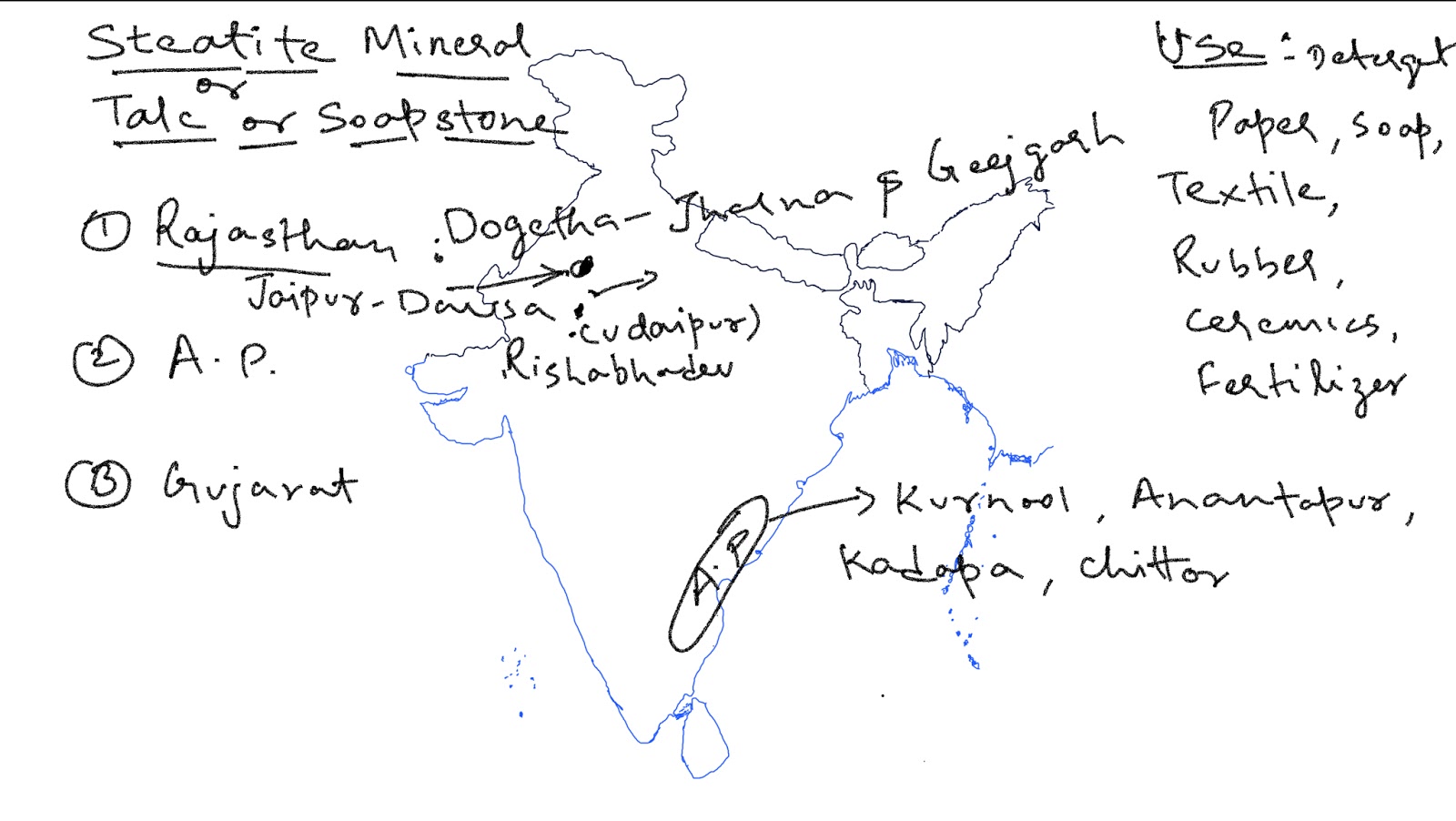
Steatite mineral or soapstone or talk
It is hydrous magnesium silicate, it is soft and soapy in nature.
Used in variety of applications due to its extreme softness & smoothness,lustre,lubricating, low moisture content, ability to absorb oil and grease, chemically inert, high fusion point, low electrical and heat conductivity, high specific heat,etc
Talc, soapstone and steatite has been declared as a minor mineral by GOI in 2015.
Major reserves: Rajasthan (57%), Uttarakhand (25%) and remaining 28% to others like AP, Bihar, Chhattisgarh,Gujarat, Jharkhand, Karnataka, Kerala, MP, Odisha, Sikkim, TN, and Telangana.
Consumption sectors : paper & textiles, Insectcides, cosmetics, ceremics and paints,
Major producers are : Rajasthan followed by AP, Gujarat......
Mines at jaipur, Bhilwara,sawai Madhopur, Udaipur